


Go HttpRouter - Cloud Functions on EdgeOne Pages
High-performance Go router powered by HttpRouter — zero-allocation routing with named parameters and wildcard support.
| Framework | Go |
| Use Case | Starter,Cloud Functions |

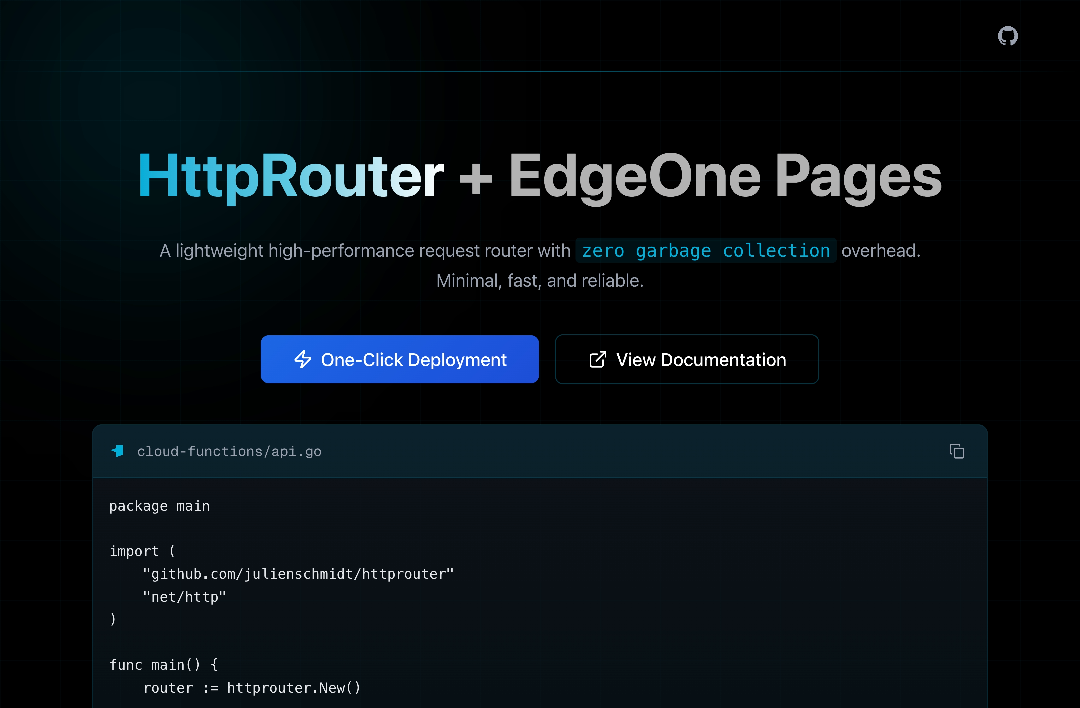
Go Cloud Functions on EdgeOne Pages - HttpRouter Framework
A full-stack demo application built with Next.js + Tailwind CSS frontend and Go HttpRouter backend, showcasing how to deploy Go Cloud Functions using the HttpRouter package on EdgeOne Pages with RESTful API routing.
🚀 Features
- HttpRouter Integration: Blazing fast, zero-allocation HTTP router with named parameters and catch-all routes
- Modern UI Design: Dark theme with #1c66e5 accent color, responsive layout with interactive elements
- Interactive API Testing: Built-in API endpoint panel — click "Call" to test each REST endpoint in real-time
- RESTful API Design: Complete Todo CRUD operations with clean route definitions (
/api/todos) - TypeScript Support: Complete type definitions and type safety on the frontend
🛠️ Tech Stack
Frontend
- Next.js 15 - React full-stack framework (with Turbopack)
- React 19 - User interface library
- TypeScript - Type-safe JavaScript
- Tailwind CSS 4 - Utility-first CSS framework
UI Components
- shadcn/ui - High-quality React components
- Lucide React - Beautiful icon library
- class-variance-authority - Component style variant management
- clsx & tailwind-merge - CSS class name merging utilities
Backend
- Go 1.21 - Cloud Functions runtime
- HttpRouter v1.3 - High-performance, zero-allocation HTTP router for Go
📁 Project Structure
go-httprouter/
├── cloud-functions/                # Go Cloud Functions source
│   ├── api.go                     # HttpRouter app with all REST API routes
│   ├── go.mod                     # Go module definition
│   └── go.sum                     # Go dependency checksums
├── src/
│   ├── app/                       # Next.js App Router
│   │   ├── globals.css           # Global styles (dark theme)
│   │   ├── layout.tsx            # Root layout
│   │   └── page.tsx              # Main page (API testing UI)
│   ├── components/               # React components
│   │   └── ui/                   # UI base components
│   │       ├── button.tsx        # Button component
│   │       └── card.tsx          # Card component
│   └── lib/                      # Utility functions
│       └── utils.ts              # Common utilities (cn helper)
├── public/                        # Static assets
│   ├── eo-logo-blue.svg          # EdgeOne logo (blue)
│   └── eo-logo-white.svg         # EdgeOne logo (white)
├── package.json                   # Project configuration
└── README.md                     # Project documentation
🚀 Quick Start
Requirements
- Node.js 18+
- pnpm (recommended) or npm
- Go 1.21+ (for local development)
Install Dependencies
pnpm install
# or
npm install
Development Mode
edgeone pages dev
Visit http://localhost:8088 to view the application.
Build Production Version
edgeone pages build
🎯 Core Features
1. HttpRouter REST API Routes
All API endpoints are defined in a single cloud-functions/api.go file using HttpRouter's explicit method routing:
| Method | Route | Description |
|---|---|---|
| GET | / | Welcome message with route list |
| GET | /health | Health check |
| GET | /api/todos | List all todos |
| POST | /api/todos | Create a new todo |
| GET | /api/todos/:id | Get todo by ID |
| PATCH | /api/todos/:id/toggle | Toggle todo completion |
| DELETE | /api/todos/:id | Delete a todo |
2. Interactive API Testing Panel
- 7 pre-configured API endpoint cards with "Call" buttons
- Real-time JSON response display with syntax highlighting
- POST request support with pre-filled JSON body
- Loading states and error handling
3. HttpRouter Framework Convention
The Go backend uses HttpRouter's standard patterns — explicit method routing and named parameters:
package main

import (
    "github.com/julienschmidt/httprouter"
    "net/http"
    "encoding/json"
)

func main() {
    router := httprouter.New()

    router.GET("/health", func(w http.ResponseWriter, r *http.Request, _ httprouter.Params) {
        w.Header().Set("Content-Type", "application/json")
        json.NewEncoder(w).Encode(map[string]string{
            "status":    "ok",
            "framework": "httprouter",
        })
    })

    router.GET("/api/todos", listTodos)
    router.POST("/api/todos", createTodo)
    router.GET("/api/todos/:id", getTodo)
    router.PATCH("/api/todos/:id/toggle", toggleTodo)
    router.DELETE("/api/todos/:id", deleteTodo)

    http.ListenAndServe(":9000", router)
}
4. Data Model
type Todo struct {
    ID        int       `json:"id"`
    Title     string    `json:"title"`
    Completed bool      `json:"completed"`
    CreatedAt time.Time `json:"createdAt"`
}
🔧 Configuration
Tailwind CSS Configuration
The project uses Tailwind CSS 4 with custom color variables:
:root {
  --primary: #1c66e5;        /* Primary color */
  --background: #000000;     /* Background color */
  --foreground: #ffffff;     /* Foreground color */
}
Component Styling
Uses class-variance-authority to manage component style variants with multiple preset styles.
📚 Documentation
- EdgeOne Pages Official Docs: https://pages.edgeone.ai/document/go
- HttpRouter: https://github.com/julienschmidt/httprouter
- Next.js Documentation: https://nextjs.org/docs
- Tailwind CSS Documentation: https://tailwindcss.com/docs
🚀 Deployment Guide
EdgeOne Pages Deployment
- Push code to GitHub repository
- Create new project in EdgeOne Pages console
- Select GitHub repository as source
- Configure build command:
edgeone pages build - Deploy project
Go HttpRouter Cloud Function
Create cloud-functions/api.go in project root with your HttpRouter application:
package main

import (
    "github.com/julienschmidt/httprouter"
    "encoding/json"
    "net/http"
)

func main() {
    router := httprouter.New()

    router.GET("/hello", func(w http.ResponseWriter, r *http.Request, _ httprouter.Params) {
        w.Header().Set("Content-Type", "application/json")
        json.NewEncoder(w).Encode(map[string]string{
            "message": "Hello from HttpRouter on EdgeOne Pages!",
        })
    })

    http.ListenAndServe(":9000", router)
}
📄 License
This project is licensed under the MIT License - see the LICENSE file for details.